Land clearing costs $1,200 to $6,000 per acre in 2026, or roughly $1.18 to $2.00 per square foot. Light brush removal runs $500–$1,500 per acre, while heavily wooded land with large trees ranges from $3,000 to $6,000 per acre. Stump removal and debris hauling are typically quoted separately and can add 20–50% to your base price.
According to LawnStarter, the national average for land clearing services is $2,581, though most residential projects fall somewhere between $1,200 and $4,500 depending on lot conditions. That average masks enormous variation driven by vegetation density, terrain complexity, and regional labor rates. Understanding these variables before you call a contractor puts you in a far stronger negotiating position.
Land Clearing Cost Breakdown: Per Acre, Per Sq Ft, and Per Hour
Most contractors price land clearing using one of three units. Knowing all three helps you compare bids accurately.
| Pricing Unit | Low Estimate | High Estimate | Best Used For |
|---|---|---|---|
| Per acre | $1,200 | $6,000 | Multi-acre rural parcels |
| Per square foot | $0.89 | $2.00 | Residential lot clearing under 1 acre |
| Per hour | $100 | $250 | Small jobs or equipment rental |
Homewyse reports a current per-square-foot baseline of $0.89–$1.45 for standard residential clearing. Hourly rates typically apply when contractors use a skid steer or excavator on a confined or irregular site where acreage pricing is impractical. Always ask which unit your quote uses — a per-hour bid on a large wooded acreage project can spiral quickly without a not-to-exceed cap.
Cost by Vegetation Density: Light Brush vs. Heavily Wooded Land
Vegetation density is the single biggest variable in any land clearing estimate. Contractors classify land into three broad tiers before pricing.
- Light brush and shrubs: $500–$1,500 per acre. A skid steer with a brush cutter attachment can cover this efficiently.
- Mixed brush with small trees (under 6 inches diameter): $1,500–$3,000 per acre. Expect a combination of chainsaw crews and mechanical equipment.
- Heavily wooded land with mature trees: $3,000–$6,000 per acre. Large-diameter trees require an excavator or feller-buncher, dramatically raising equipment and labor costs.
According to data from skidsteers.com, brush clearing alone spans $500–$5,600 per acre depending on density — a tenfold range that explains why two neighboring parcels can carry wildly different quotes. The average cost to clear 1 acre of heavily wooded land sits near $4,500 when stump removal is included.
Cost by Lot Size: Residential Parcels vs. Multi-Acre Projects
Lot size affects unit pricing because larger projects spread equipment mobilization costs across more acreage.
- Under 1 acre (residential lot): $500–$2,500 total. Per-square-foot pricing is most common here.
- 1–5 acres: $1,200–$12,500. Contractors often discount the per-acre rate slightly above 2 acres.
- 10 acres: $12,000–$45,000 depending on tree coverage.
- 20 acres: $24,000–$120,000. At this scale, vegetation density and terrain complexity dominate the final number far more than lot size itself.
For a 20-acre project, get at minimum three itemized quotes. A $20,000 spread between bids is common and almost always traces back to different assumptions about debris disposal and stump removal scope.
Key Factors That Drive Your Final Quote Up or Down
Five variables explain most of the price spread you will see across contractor bids.
- Terrain complexity: Steep slopes, rocky soil, or wet ground slows equipment and raises hourly costs.
- Tree size and species: Hardwoods with large root systems cost more to remove than pine or scrub.
- Debris disposal method: On-site burning (where permitted) is cheapest; haul-away to a landfill adds $200–$600 per load.
- Stump removal: Stump grinding runs $100–$400 per stump or $150–$500 per hour and is almost always a separate line item.
- Regional labor rates: Clearing in the Southeast typically runs 20–30% less than the same job in the Northeast or Pacific Northwest.
Daniel Dean’s cost research confirms that per-acre pricing ranges from $1,200 to $6,000 with explicit attribution to these exact variables — terrain and vegetation density account for the bulk of that $4,800 spread.
Stump Removal and Debris Disposal: Often Quoted Separately
Most base land clearing quotes cover cutting and grading only. Stump removal and debris hauling are frequently excluded — a detail that catches property owners off guard when the final invoice arrives.
Stump grinding adds $100–$400 per stump for standard sizes. A one-acre lot with 30 mature trees could add $3,000–$12,000 to your project in stump removal alone. Review our stump removal cost guide for a full breakdown by stump diameter and method.
Debris disposal has three options: on-site chipping (cheapest), burning (requires a permit in most counties), or haul-away ($200–$600 per truckload). Always confirm which method is included in your quote before signing.
How to Read and Audit a Land Clearing Contractor Quote
A professional land clearing quote should include at minimum eight line items. If any are missing, request them before comparing bids.
Required line items in every quote:
- Site mobilization and equipment transport fee
- Clearing method (mechanical, manual, or combination)
- Acreage or square footage being cleared
- Tree size classification and density tier
- Stump removal (included or excluded — stated explicitly)
- Debris disposal method and number of haul-away loads
- Permit procurement responsibility (contractor or owner)
- Land surveying costs if boundaries are unmarked
Woodland Mills notes that land surveying alone costs $500–$20,000 depending on parcel size and complexity — a pre-clearing expense that belongs in your total budget even if it’s not on the clearing contractor’s invoice. Use our land clearing cost calculator to build a baseline before reviewing quotes.
Red Flags in Land Clearing Quotes (and How to Negotiate)
Certain patterns in a contractor quote signal either inexperience or an attempt to lowball the bid and recover margin through change orders.
- Lump-sum bid with no itemization: Ask for a full line-item breakdown. If the contractor refuses, walk away.
- No mention of permits: In most jurisdictions, clearing requires at least a grading or tree removal permit. A quote that ignores this is incomplete. Counter by asking the contractor to confirm permit responsibility in writing.
- No debris disposal clause: This is the most common source of surprise charges. Negotiate a fixed per-load rate or a not-to-exceed total before work begins.
- No equipment specification: “We’ll use our machines” is not an acceptable answer. An excavator and a skid steer carry very different hourly rates. Require the quote to name the equipment.
Learn more about vetting contractors in our guide on how to hire a land clearing contractor.
Permits and Regulations: What You Must Know Before Clearing
Yes, you almost certainly need a permit to clear your own land — even if you own it outright. Permit requirements vary significantly by state, county, and municipality, but most jurisdictions regulate land clearing through at least one of the following frameworks.
Check these four areas before signing any contract:
- Local zoning and grading permits: Most counties require a grading permit for any clearing over 5,000 square feet or one acre.
- Wetland buffer rules: The Army Corps of Engineers regulates clearing within 100 feet of wetlands under Section 404 of the Clean Water Act. Violations carry fines up to $25,000 per day.
- Tree ordinances: Many municipalities protect trees above a certain diameter. Removing them without a permit triggers fines and mandatory replacement planting.
- HOA covenants: Subdivision rules often restrict clearing to specific seasons or percentages of lot coverage regardless of local law.
Review land clearing permit requirements by state to confirm what applies to your parcel before any equipment arrives on site.
How to Get the Most Accurate Land Clearing Estimate
Follow these four steps to arrive at a quote you can trust and defend.
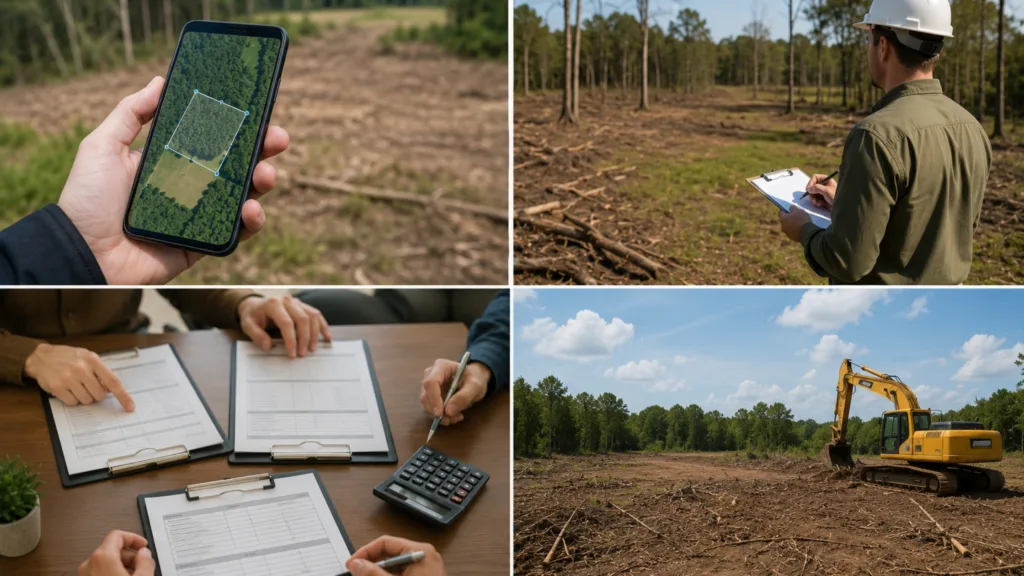
- Measure your site accurately. Use a GPS property boundary app or hire a surveyor. Contractors who eyeball acreage often underbid and recover costs through change orders.
- Classify your vegetation. Walk the parcel and count trees over 6 inches in diameter. Note any wet areas, slopes over 15%, or rock outcroppings — all of these trigger higher rates.
- Get three itemized quotes. Require all contractors to bid on an identical scope: same acreage, same stump removal assumption, same debris disposal method. This is the only way to compare bids apples-to-apples.
- Run a cost calculator baseline first. Use a land clearing cost calculator to establish a reasonable range before you contact your first contractor. Walking into a quote conversation with a number in mind changes the dynamic entirely.
Explore residential land clearing services to find qualified contractors who provide itemized quotes by default.
FAQs
1. How much does it cost to clear 20 acres of land?
Clearing 20 acres cost $24,000–$120,000 in 2026. The final number depends almost entirely on vegetation density and terrain. Lightly brushed land runs $500–$1,500 per acre; heavily wooded acreage with mature hardwoods runs $3,000–$6,000 per acre. Always get three itemized bids for projects this size.
2. Do I need a permit to clear my own land?
In most cases, yes. Local grading permits, state tree ordinances, and federal wetland buffer rules under the Clean Water Act apply to the majority of clearing projects regardless of ownership. Check with your county planning department to verify wetland boundaries before any work begins.
3. How long does it take to clear 3 acres of land?
A professional crew with a skid steer and excavator can clear 3 acres of light brush in 1–2 days. Heavily wooded land of the same acreage typically takes 3–5 days. Stump grinding and debris haul-away add additional time on top of the clearing phase.
4. How is land clearing cost estimated per square foot versus per acre?
Per-acre pricing is standard for parcels over 1 acre; per-square-foot pricing is common for residential lots under 43,560 square feet. The math converts directly: $1.50 per square foot equals $65,340 per acre. Always confirm which unit a contractor is using to avoid misreading a quote.
5. What is the average cost to clear 1 acre of heavily wooded land?
Expect $3,000–$6,000 per acre for heavily wooded land, with the national average landing near $4,500 when stump removal is included. Large-diameter hardwoods, rocky terrain, and haul-away disposal push costs toward the upper end of that range.
6. What should a land clearing quote include?
A complete quote should itemize mobilization fees, clearing method, acreage, tree density classification, stump removal status, debris disposal method, permit responsibility, and any surveying costs. Missing line items are the primary source of change-order disputes after work begins.
7. How much does stump removal add to land clearing costs?
Stump grinding typically adds $100–$400 per stump or $150–$500 per hour. On a densely wooded acre with 30+ trees, stump removal can match or exceed the base clearing cost. Always confirm whether stumps are included or excluded before accepting any bid.
8. What factors cause land clearing prices to vary so widely?
The five primary drivers are vegetation density, tree size and species, terrain complexity, debris disposal method, and regional labor rates. A flat, lightly brushed lot in rural Alabama and a steep, heavily wooded parcel in Vermont can differ by $4,000 or more per acre even with identical square footage.