Commercial land clearing services cover the full scope of vegetation removal and site preparation needed before construction begins. This includes tree removal, stump grinding, brush removal, grading preparation, and debris disposal across large parcels. Contractors use mechanical, manual, or mulching methods depending on site conditions, vegetation density, and local regulations.
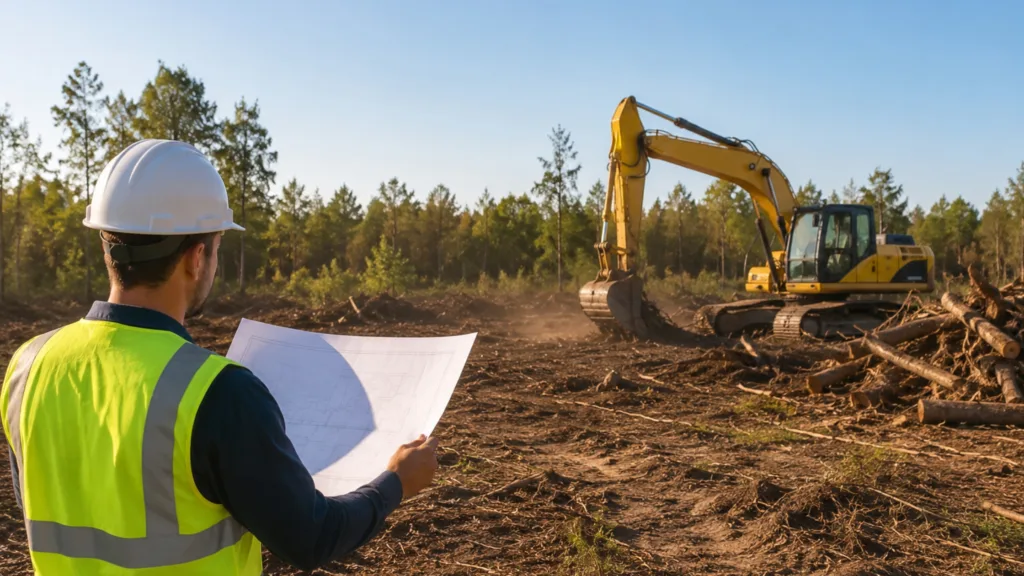
What Commercial Land Clearing Services Actually Include
Commercial land clearing is the process of removing trees, shrubs, brush, stumps, and other vegetation from a parcel to prepare it for development. According to Concord Land Clearing, this work spans the removal of all above- and below-ground vegetation from large commercial sites, leaving a clean, buildable surface. A full-service engagement typically includes tree removal, stump grinding and removal, brush clearing, debris hauling, and grading prep to meet engineering specifications.
Michigan Land Clearing Services describes commercial clearing as a multi-phase process that addresses not just visible vegetation but root systems, soil disturbance, and drainage considerations. Atlanta Land Clearing notes that commercial projects frequently involve mixed vegetation types — from dense cedar stands to overgrown brush — each requiring different equipment and labor approaches. Debris disposal is a critical component: cleared material is either chipped on-site, hauled to a landfill, or converted into mulch depending on project scope and local disposal regulations.
Site preparation does not end when the last tree falls. Contractors must also address erosion control measures and coordinate with grading crews to ensure the cleared site is ready for the next phase of construction.
Common Commercial Land Clearing Methods Compared
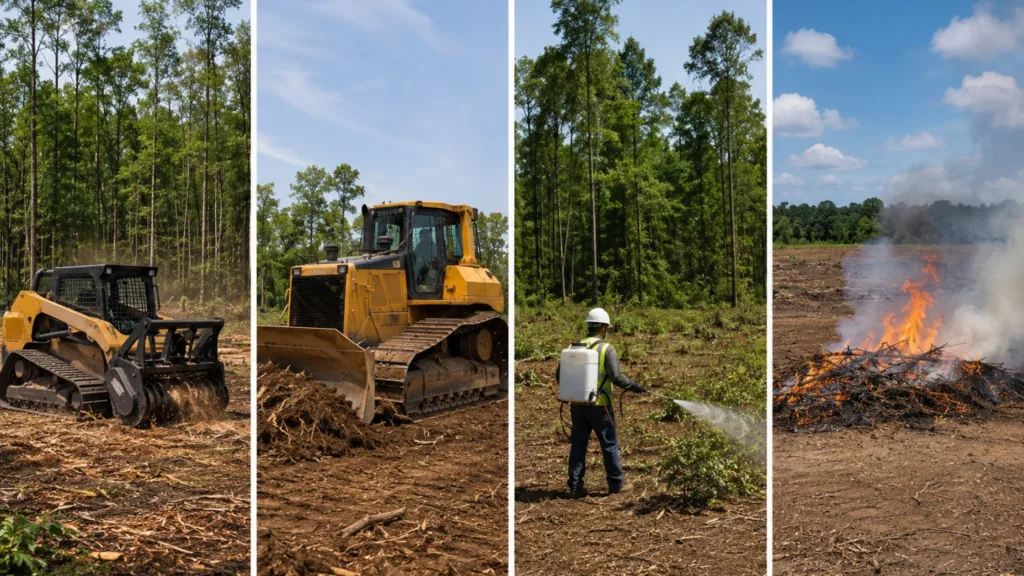
Four primary methods are used in commercial land clearing: mechanical clearing, manual clearing, chemical clearing, and controlled burning. Each carries different cost profiles, timelines, and regulatory constraints.
Mechanical clearing uses bulldozers, forestry mulchers, excavators, and brush cutters. It is the most common approach for commercial-scale acreage clearing. Manual clearing relies on hand crews with chainsaws and hand tools — practical for small parcels or sensitive areas near utilities. Chemical clearing uses herbicides to kill vegetation before mechanical removal; it requires applicator licensing and is subject to EPA and state environmental regulations. Controlled burning is the least expensive method per acre but is heavily restricted or prohibited in most commercial development contexts due to air quality regulations and liability exposure.
Forestry Mulching: Best Use Cases for Commercial Sites
Forestry mulching uses a single machine — a forestry mulcher — to grind trees, brush, and stumps directly into mulch that remains on-site as ground cover. This method eliminates debris hauling costs and leaves a layer of organic material that actively reduces soil erosion. For large commercial parcels with moderate tree density, forestry mulching typically costs 30–50% less than traditional cut-and-haul methods.
Forestry mulching is ideal for utility corridors, pipeline rights-of-way, solar farm preparation, and commercial parcels where topsoil preservation matters. This is not appropriate for sites requiring full grubbing of root systems or where deep foundation work is planned, since mulched material left in the soil can interfere with compaction testing.
Bulldozing and Grubbing: When Heavy Equipment Is Required
Bulldozing and grubbing is necessary when a site contains dense timber, large-diameter stumps, or requires deep soil disturbance for foundations, utilities, or underground infrastructure. Bulldozers push over trees and root systems entirely, while grubbing removes stumps and roots to a specified depth — typically 12 to 18 inches below grade for commercial construction.
Equipment used in this process includes D6 and D8 bulldozers, hydraulic excavators with thumb attachments, and root rakes. This method disturbs more topsoil than forestry mulching and generates significant debris volume, increasing hauling costs. It is the required approach for sites moving into immediate construction site grading and foundation work.
Commercial Land Clearing Cost Breakdown per Acre
Commercial land clearing costs range from $500 to $5,600 per acre depending on vegetation density. Lightly wooded or brush-only land averages $500–$1,500 per acre. Moderately wooded sites run $1,500–$3,000. Heavily wooded parcels with large trees and stumps can reach $3,000–$5,600 per acre, excluding permit and hauling fees.
| Vegetation Type | Average Cost Per Acre |
|---|---|
| Brush and light scrub only | $500 – $1,500 |
| Moderately wooded (mixed trees) | $1,500 – $3,000 |
| Heavily wooded (large timber + stumps) | $3,000 – $5,600 |
These figures represent clearing labor and equipment only. Permit fees, debris hauling, stump grinding and removal, and erosion control materials are typically billed separately. For a full breakdown of cost variables, see our land clearing cost guide.
Key Factors That Drive Your Total Project Cost
Seven variables have the greatest impact on your total commercial land clearing budget:
- Acreage — larger parcels benefit from economies of scale but require more mobilization time.
- Vegetation density and tree species — hardwoods like oak and hickory take longer to process than softwoods.
- Stump count and diameter — stump grinding and removal is priced per stump or per hour and adds $150–$450 per large stump.
- Debris hauling distance — disposal fees increase with distance to approved landfills or recycling facilities.
- Soil conditions — rocky or wet soils slow equipment and increase labor hours.
- Permit fees — grading permits, wetlands review fees, and erosion plan approvals range from $500 to $5,000+ depending on jurisdiction and project size.
- Site access — remote parcels with limited road access require additional equipment mobilization costs.
Permits, Environmental Compliance, and Site Regulations
Commercial land clearing almost always requires permits before work begins. The most critical federal requirement is a Section 404 wetlands permit under the Clean Water Act, administered by the U.S. Army Corps of Engineers. Any clearing within or adjacent to wetlands, streams, or jurisdictional waters requires a Section 404 review — violations can carry fines of up to $25,000 per day.
At the state and local level, most jurisdictions require a grading permit and an approved Erosion and Sediment Control (ESC) plan before vegetation clearing can begin. Many counties also require a protected species survey — particularly for sites that may host threatened species such as gopher tortoises, Indiana bats, or red-cockaded woodpeckers. Clearing without these approvals can result in stop-work orders, fines, and project delays measured in months.
Qualified land clearing contractors should assist with permit identification and documentation. If a contractor cannot name the permits required for your site, that is a serious red flag.
How Long Does Commercial Land Clearing Take?
Clearing 100 acres of commercial land typically takes 2 to 6 weeks, depending on vegetation density, method, and crew size. A forestry mulcher operating on moderately wooded land can process 3 to 5 acres per day. A bulldozing and grubbing operation in heavily wooded terrain may clear 1 to 2 acres per day.
| Acreage | Method | Estimated Duration |
|---|---|---|
| 1–5 acres | Forestry mulching | 1–3 days |
| 10–25 acres | Mechanical mixed methods | 1–2 weeks |
| 50–100 acres | Full mechanical crew | 3–6 weeks |
| 100+ acres | Multi-crew operation | 6–12 weeks |
Weather, permit delays, and equipment downtime are the most common causes of schedule overruns. Build a 15–20% schedule buffer into any commercial clearing timeline.
How to Vet and Hire a Commercial Land Clearing Contractor
Hiring the wrong contractor is one of the most expensive mistakes a developer can make. Use this checklist before signing any contract:
- Licensing: Verify that the contractor holds a valid state contractor’s license for land clearing or site preparation work in your jurisdiction.
- Equipment fleet: Confirm that the contractor owns — not rents — the equipment required for your site. Rented equipment signals limited capacity.
- Insurance: Require certificates showing general liability insurance ($1M minimum per occurrence) and workers’ compensation coverage.
- Commercial references: Ask for three references from commercial projects of similar acreage. Call them.
- Permit assistance: A qualified contractor should identify required permits and assist with documentation.
- Lien waivers: Require conditional lien waivers from the contractor and all subcontractors at each payment milestone.
- Written scope of work: Every service — tree removal, stump grinding, debris hauling, erosion control — must be itemized in the contract.
Engaging a contractor experienced in site preparation services ensures continuity between clearing and the next phase of development.
Red Flags to Watch for in Contractor Bids
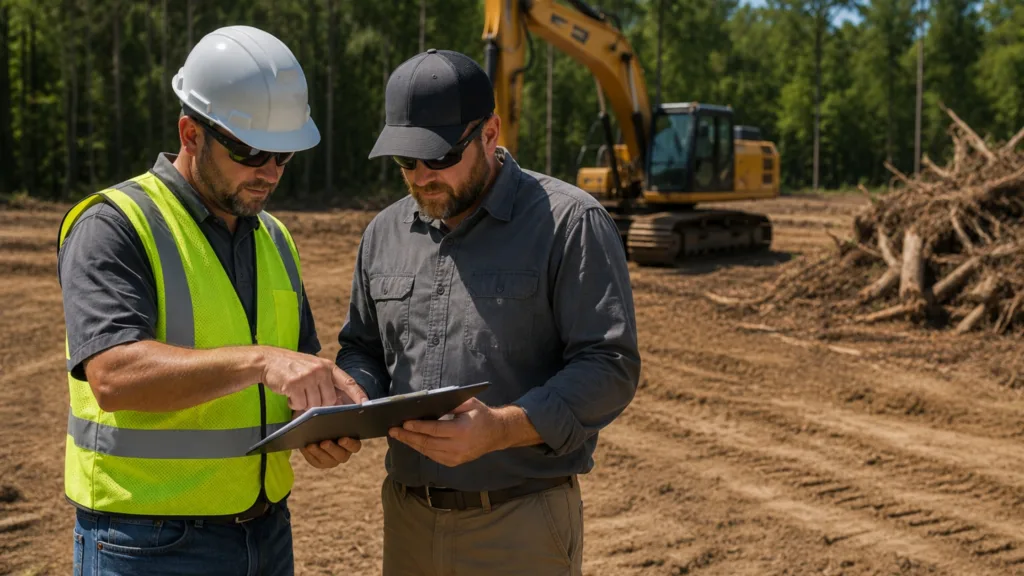
Watch for these warning signs in contractor proposals:
- No written scope of work — verbal agreements on debris disposal or stump depth create costly disputes.
- Unusually low bids — bids 30%+ below market average typically exclude stump removal, hauling, or permit costs that will surface later as change orders.
- No permit assistance — contractors unfamiliar with local permitting requirements put your project at legal risk.
- Vague debris disposal terms — confirm where cleared material goes and who bears the disposal cost.
- No proof of insurance — any hesitation to provide current certificates is an immediate disqualifier.
Preparing Your Site After Clearing: Next Steps
Once vegetation clearing is complete, four immediate steps protect your investment and keep the project on schedule. First, conduct soil testing to identify bearing capacity, contamination, and compaction requirements before grading begins. Second, implement erosion control solutions — silt fencing, erosion blankets, and hydroseeding — within 24 to 48 hours of clearing to comply with ESC plan requirements and prevent topsoil loss.
Third, have all underground utilities marked by your state’s 811 call-before-you-dig service before any grading equipment moves on-site. Fourth, engage your grading contractor to review the cleared site and confirm it meets the elevation and drainage specifications in your civil engineering drawings. Clearing and grading should be treated as a continuous workflow, not sequential phases with gaps between them.
FAQs
1. What is commercial land clearing and what does it include?
Commercial land clearing is the removal of trees, stumps, brush, and other vegetation from a large parcel to prepare it for development. It includes tree removal, stump grinding, brush removal, debris disposal, and grading preparation. The goal is a clean, stable site ready for construction activity.
2. How much does it cost to clear an acre of commercial land?
Commercial land clearing costs range from $500 to $5,600 per acre. Brush-only or lightly wooded land averages $500–$1,500 per acre. Moderately wooded sites run $1,500–$3,000. Heavily wooded parcels with large stumps can reach $3,000–$5,600 per acre, not including permits or debris hauling.
3. How long does it take to clear 100 acres of land?
Clearing 100 acres typically takes 3 to 6 weeks with a full mechanical crew, depending on vegetation density and method. A forestry mulcher can process 3–5 acres per day on moderately wooded land. Dense timber with large stumps slows progress to 1–2 acres per day.
4. What is the cheapest method of clearing land for commercial development?
Forestry mulching is generally the most cost-efficient method for large commercial parcels. It eliminates debris hauling by grinding vegetation into on-site mulch and reduces erosion. Chemical clearing has a lower upfront cost but requires licensed applicators and carries regulatory restrictions that make it impractical for most commercial timelines.
5. What permits are required before clearing commercial land?
Most commercial clearing projects require a local grading permit, an Erosion and Sediment Control plan, and potentially a Section 404 wetlands permit from the U.S. Army Corps of Engineers if the site is near jurisdictional waters. Protected species surveys may also be required depending on site location and state regulations.
6. How do I choose a qualified commercial land clearing contractor?
Verify state licensing and general liability insurance of at least $1M per occurrence and workers’ compensation coverage. Request references from commercial projects of similar scale, confirm the contractor owns its equipment, and ensure the contract includes a written scope covering tree removal, stump grinding, debris hauling, and permit responsibilities.
7. What equipment is used in commercial land clearing projects?
Common equipment includes forestry mulchers, bulldozers (D6/D8 class), hydraulic excavators with thumb and root rake attachments, brush cutters, stump grinders, and debris hauling trucks. The specific equipment mix depends on vegetation type, acreage, and whether the site requires full grubbing or surface-level clearing only.
8. What happens to trees, stumps, and debris after commercial land clearing?
Cleared material is handled three ways: chipped or mulched on-site (common with forestry mulching), hauled to an approved landfill or transfer station, or sold to timber buyers if the site contains merchantable lumber. Stumps are either ground down in place or fully excavated depending on the foundation and grading requirements. Debris disposal terms should always be specified in the contractor agreement.